
Vehicle Rental Management System: From Paper to Online Booking
Updated: Jul 10
Summary: An online reservation system streamlines vehicle rental and limousine operations, letting companies manage bookings and availability without manual scheduling.
A vehicle rental management system is web-based software that runs your rental operation in one place, from the customer's first booking through the rental agreement, vehicle check out and check in, billing and reporting. It replaces the paper agreements, spreadsheets and phone-based scheduling that most small fleets still rely on, so bookings, availability and invoices all read from the same record.
If you run a rental or limousine fleet, you already know where the day goes. It goes into re-typing the same customer details into a third form, into checking whether a car someone promised over the phone is actually free, and into chasing a signature on an agreement that is sitting in a folder on someone's desk.
This article walks through what a vehicle rental management system actually does, what the move from paper looks like in practice, and where an online booking engine fits on top. DewTouch builds two products that cover this ground, and we will be clear about which one does what.

What is a vehicle rental management system?
A vehicle rental management system is a single platform that holds your customers, your vehicles, your rates and your agreements, and keeps them in sync. When a booking is made, the vehicle is marked as reserved for those dates straight away, so nobody can promise the same car twice. The rental agreement, the deposit, the check out and the eventual invoice all attach to that one booking rather than living in separate files.
The value for an owner is simpler to state. One record per rental means your team stops re-keying the same information, and your availability, your cash position and your vehicle history stop disagreeing with each other.
That is the difference between a system and a set of spreadsheets that happen to sit next to each other.
Fleetnetics is the automotive ERP software DewTouch built for exactly this. It digitalises the administrative and operational workflow of vehicle rental and leasing on one web-based platform, alongside workshop and spare parts operations for businesses that run those too. You can see the full module set on the vehicle rental and leasing management system page.
What does a rental operation look like without one?
Picture the first hour of a fleet manager's morning on a paper-and-Excel setup. A customer calls to extend a hire, so someone opens the physical agreement folder to find the original terms.
A second customer walks in for a booking made yesterday, and the counter staff cannot see it because it was written on a different person's notepad. The availability spreadsheet says a Vios is free, but that Vios came back with a scratched bumper last night and nobody has updated the sheet. Three separate people are now re-typing the same customer's IC and licence details into three separate documents.
Every one of those re-keyings is a chance to introduce an error, and the error rate is not trivial. Independent research puts the manual data entry error rate at around 1% for a focused operator and 3% to 4% under normal conditions of fatigue and time pressure, according to a 2026 review of data-quality studies by Lido.
The cost of each mistake compounds the later it is caught. Data-quality researchers describe a 1-10-100 rule: a mistake costs roughly a dollar to fix at the point of entry, ten times that once it is in your processing, and a hundred times that once it reaches a customer or a compliance record. A wrong rate on an invoice or a double-booked car is exactly the kind of error that surfaces late.
Now run the same morning on a rental management system. The extension is a few clicks on the existing agreement. The walk-in booking is already on the calendar, visible to whoever is at the counter. The scratched Vios was marked as damaged at check in, so it never appeared as available in the first place. The customer's details were entered once and carry across the quotation, the booking and the agreement without re-typing. For an owner, the point is not the clicks saved. The point is that the errors that cost you real money at settlement mostly stop happening.
No commitment on your side. We will look at how a booking moves through your operation today and show you where the same detail gets typed more than once. Get a demo →
The digitalisation roadmap: from paper and Excel to online booking
Most operators do not go from a paper folder to a fully automated online storefront in one step, and they should not try to. It helps to think of the move in three stages, so you can stop at the one that matches your size and add the next when the volume justifies it.
Stage one: Single source of Information
At this stage, all you need to do is to get your customers, vehicles, rates and agreements into one system so that availability and billing stop contradicting each other. This stage is essential for companies of all sizes, but if your fleet sits under twenty vehicles, this stage alone removes most of the daily friction, and you can reasonably defer the rest.
Stage two: The digital rental agreement
This is where Fleetnetics does the heavy lifting. You can create a Rental Quotation or an Advance Booking, and either one converts into a Rental Agreement without re-keying, so the same customer and vehicle details carry straight through.
The vehicle handover then runs through a structured Check Out and Check In. The vehicle layout carries forward any damage recorded at the previous check out, so a dispute is settled by comparing two checklists rather than two memories.

Lastly, billing runs on your terms, forward billing before the rental period or arrears billing after, which gives you a lever over your own cash flow.
Stage three: online booking
Once your agreements are digital, you can let customers book themselves. This is where Booknetics comes in, the DewTouch booking and reservation platform for vehicle rental and chauffeur services.

Booknetics is a separate product from Fleetnetics, built by the same company, and it adds the customer-facing online booking layer that sits in front of the operation. It covers two booking models, self-drive rental and chauffeured limousine service, so the same platform serves a customer who drives themselves and a customer who books a driver. The two products together take you from a folder on a desk to a booking a customer can make at midnight.
For a decision maker, the sequencing is the useful part. You are not signing up for a two-year transformation. You are moving in stages that each pay for themselves before the next one starts.
How does self-drive online booking work for customers?

Self-drive online booking lets a customer reserve a vehicle and drive it themselves, start to finish, without anyone on your team answering the phone. In Booknetics, a customer checks live vehicle availability, picks the car they want, and completes the reservation online.
Along the way they can add extra items such as insurance, so the cover is chosen and priced at the point of booking rather than negotiated at the counter. They can also add a delivery or pickup request, which tells you where the vehicle needs to be and when, and then make payment online to confirm the booking.
Customers moving a group can book several vehicles in one go, chosen by type or by what is actually available. Custom branding means the booking page carries your identity, so the experience reads as yours rather than a generic portal.
For an owner, the value is that a booking made at 11pm is a confirmed, paid reservation the next morning, with the insurance and the delivery already attached, rather than a voicemail your staff have to call back and rebuild by hand.
How does limousine and chauffeur booking work?
Limousine and chauffeur booking adds the driver as a first-class part of every job, because a chauffeured rental is only as good as the coordination behind it.
For airport work, real-time flight integration syncs the flight details so vehicle and driver assignments line up with the actual arrival rather than the scheduled one. A visual route map with distance-based rate calculation, drawn from Google Maps data, lets a customer see the journey and understand the price before they commit, which cuts the back-and-forth that kills a booking.
On the operations side, Booknetics gives drivers a portal where they can see upcoming bookings and schedules in a calendar view, so a chauffeur knows the day's jobs without a phone call. LINE integration lets you communicate with drivers directly on a channel they already use, which keeps updates flowing without a separate app to learn.
Automated communication handles the email confirmations for both drivers and customers, and sends cancellation notifications when a reservation falls through, so a cancelled job does not leave a driver waiting at a kerb.
How does the back office manage bookings and fleet availability?
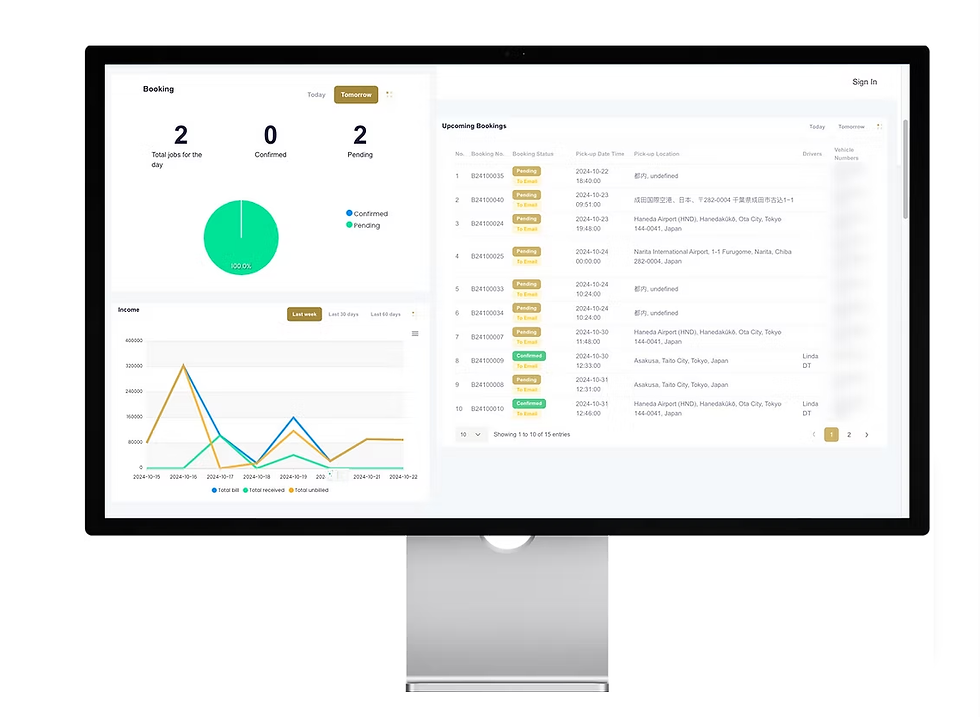
Behind the booking page, the admin panel is where your team manages every reservation, tracks which vehicles are free and updates rates, all from one calendar view. The calendar is the anchor, giving you a single place to schedule and plan rather than a spreadsheet that three people edit at once.
Vehicle and driver management lets you block certain dates or restrict bookings on specific vehicles, and to keep fleet availability accurate as cars move in and out of service. Real-time vehicle location is available through integration with a third-party GPS, so you can see where a car is when you need to.
Rates management covers the pricing models a rental business actually uses, by trip, by hour or by distance, with an additional late-night surcharge where it applies. Customer management handles both individual and corporate accounts, with special pricing for corporate clients and a corporate login so a company can book on behalf of its own staff. Before you hand over a vehicle, you can also run a background check on a driver or company.
For an owner, accurate availability is the line that protects revenue. A car that shows as free when it is not is a cancelled booking and an unhappy customer, and a car that shows as busy when it is free is a loss in your revenue.
How are payments and invoicing handled?
Payments can run through a secure gateway that accepts card and electronic payment, with a clear view of each transaction's status, date and amount. Billing supports invoice generation, batch invoicing for volume, and different payment modes and terms, which matters once you are handling corporate accounts on net terms.
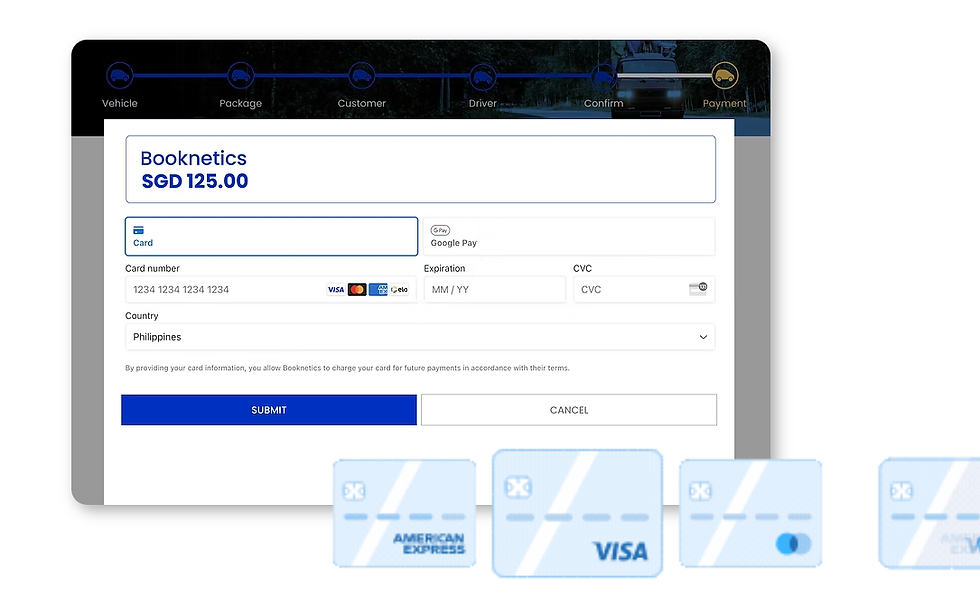
When a rental is cancelled, refunds and credit notes let you settle it cleanly rather than tracking an adjustment on the side. Add-on items such as child seats or a foreign-speaking driver can be attached to a booking with their own pricing, so extras are billed rather than forgotten.
Key features versus business benefits
The point of a rental management system is never the feature. It is the operational cost the feature removes. In this table, we will map one to the other.
Feature | What it does | Business benefit |
Centralised booking calendar | Marks a vehicle as reserved the moment it is booked | Removes double bookings and the disputes that follow |
Advance Booking to Rental Agreement | Converts into an agreement without re-keying | Cuts re-entry, the main source of the 1% to 4% manual error rate |
Check Out and Check In with damage layout | Records vehicle condition against a carried-forward layout | Settles damage disputes by comparing checklists, not memories |
Forward and arrears billing | Charges before or after the rental period | Gives you a direct lever over cash flow timing |
Self-drive online booking (Booknetics) | Lets customers check availability, add insurance and delivery, and pay online | Captures paid, after-hours bookings without staff on the phone |
Limousine and chauffeur booking (Booknetics) | Adds driver portal, flight sync and route-based rates | Coordinates chauffeured jobs without manual dispatch calls |
Third-party GPS integration | Shows real-time vehicle location | Improves recovery and utilisation |
Corporate accounts and pricing (Booknetics) | Holds special rates and a corporate login | Wins and retains business clients on their own terms |
Automated confirmations and reminders | Emails drivers and customers automatically | Reduces no-shows and the manual chase that precedes them |
Where Fleetnetics fits
E-Cube Car Rental, a Singapore rental and leasing operator with a mixed fleet of passenger and commercial vehicles, faced rising demand and needed to digitalise across every department at once.
After moving onto Fleetnetics, E-Cube Car Rental moved every department onto one system, automated its daily workflows and tailored the platform to how each department actually works, on a system its staff picked up quickly.
DewTouch, the company behind Fleetnetics, was founded in Singapore in 2012 and reports a 99% customer retention rate. Businesses on the platform have managed more than 180,000 rental agreements to date, as of July 2026.
For a car rental owner weighing the move, the honest summary is this. Fleetnetics digitalises the agreement and the operation, Booknetics puts booking in your customers' hands, and you can adopt them in the order that matches your size. The alternative, staying on paper and Excel, is not free. It carries a running cost in re-entry, errors and lost availability that you are paying today whether or not it shows up on an invoice.
No commitment. We will map your current rental agreement and check-in flow and show you what a single system looks like for your fleet. Get a demo →
Want customers to book online themselves? Booknetics adds the reservation layer. Visit Booknetics →
FAQ Content
What is a vehicle rental management system?
A vehicle rental management system is web-based software that manages the full rental process in one platform, from booking and rental agreement through vehicle check out and check in, billing and reporting. It keeps customers, vehicles, rates and availability in sync, so your team stops re-entering the same details and your availability stays accurate.
What is the difference between Fleetnetics and Booknetics?
Fleetnetics and Booknetics are both DewTouch products that serve different layers. Fleetnetics is the automotive ERP that digitalises your rental agreements, check out and check in, billing and fleet operations. Booknetics is the online booking and reservation platform that lets your customers reserve vehicles themselves, across two booking models, self-drive rental and chauffeured limousine. Many operators run Fleetnetics for operations and add Booknetics for online booking.
How does self-drive online booking work in Booknetics?
In Booknetics self-drive booking, a customer checks live vehicle availability, selects a car, and completes the reservation online. They can add extra items such as insurance, add a delivery or pickup request, and pay online to confirm. The booking arrives as a paid, confirmed reservation with the extras already attached, so your counter staff do not rebuild it by hand.
Can a rental management system handle limousine and chauffeur bookings?
Yes. Booknetics supports chauffeur and limousine services with a driver portal for viewing schedules, LINE integration for direct driver communication, and automated confirmations and cancellation notifications. It also handles distance-based, hourly and trip-based rates plus late-night surcharges, which are the pricing models limousine operators typically use.
Does a vehicle rental management system track vehicles with GPS?
Real-time vehicle location is available through integration with a third-party GPS provider rather than built-in hardware. The system shows where a vehicle is when you need it, which supports recovery and utilisation, while the GPS device and data come from the integrated provider.
How do I move my rental business from paper and Excel to a booking system?
Move in stages, and in the order that fits you. Most operators first bring customers, vehicles, rates and agreements into one system, then digitalise the rental agreement and handover, then add online booking. A smaller fleet can stop after the first stage and grow into the rest, or start with online booking to drive revenue and reach, then formalise operations later.
Read more:

