
What Is Automotive ERP Software?
Summary: Automotive ERP software is a unified system that connects your operations and finance, replacing fragmented tools to eliminate manual data re-entry. If your business runs multiple revenue streams like vehicle rentals and workshops, this system ensures every vehicle, job, and invoice stays perfectly in sync without the usual month-end reconciliation headache.
Automotive ERP software is a single connected system that runs the operational and financial side of an automotive business, holding vehicles, jobs, parts, customers, agreements and accounts on one shared database. Rental operators, workshops, parts distributors and vehicle sales teams use it in place of separate tools that do not talk to each other.
That definition is worth stating plainly, because most articles on this term were written for vehicle manufacturers. If you rent out cars, repair them, or sell parts over a counter, the standard explanation describes somebody else's business.

What does automotive ERP software actually do?
The manufacturing version of this category is concerned with production scheduling, assembly sequencing and Tier-1 supplier compliance. Those things matter if you build components. They describe very little of your working week if your revenue comes from vehicles in service.
For the automotive aftermarket, an ERP does something narrower and more useful. It holds one record of every vehicle, customer, job, part and invoice, and each record updates the others. When a mechanic closes a job, the parts leave stock and the invoice picks up the labour and the parts without anyone re-typing them.
Separate systems tend to slow a business at the joins. Each tool may work perfectly well on its own, and your staff still end up carrying information across the gaps by hand.
For an owner, the figure worth measuring is the number of hours your team spends moving the same information between systems. That cost repeats every week whether or not you ever buy software.
Automotive ERP software vs workshop and rental management software
Workshop management software and rental management software each solve one department well. Automotive ERP software covers several departments and connects them to your accounts, which is the difference that matters when you run more than one revenue line.
Workshop or rental point tool | Automotive ERP | |
Scope | One department, such as job cards or reservations | Rental, workshop, parts, vehicle sales and finance together |
Finance | Exports to a separate accounting package | Receivables, payables and accounting inside the same system |
Master data | Customer and vehicle records are duplicated in each tool | One customer, supplier and vehicle record shared across modules |
Reporting | Accurate within one department | Across departments, on the same set of figures |
Suited to | A business with a single revenue line | A business with two or more revenue lines |
Trade-off | Faster to adopt and simpler to run | Longer to implement, and it requires a data clean-up first |
That last row deserves attention rather than a footnote. An ERP asks you to tidy your customer list, your vehicle list and your chart of accounts before go-live, and that work is real. If you are weighing this against a cheaper point tool, our note on judging whether the spend is justified sets out the questions to ask.
For a finance director, the deciding question is usually how many staff hours currently go into reconciling two systems at month end, since that figure is what the migration effort is being traded against.
Which automotive businesses need an ERP, and which can reasonably wait?
Some businesses genuinely do not need one yet, and it is better to say so than to sell into a bad fit.
You are likely ready when several of these are true:
You run two or more revenue lines, such as rental and leasing operations alongside a workshop, and the two keep separate records of the same vehicles.
Your staff re-key the same customer or vehicle details into a second system every day.
Your stock count never reconciles, because parts leave the counter without a job number attached.
Month-end close takes more than a week, and most of that week goes into chasing figures rather than reviewing them.
You have lost a damage dispute or a deposit argument because nobody could produce the record.
You can reasonably wait when your business runs on one revenue line, your fleet sits under roughly twenty vehicles, one person handles the admin comfortably, and your current tool has not failed you. Buying an ERP to solve a problem you do not have yet is an expensive way to create one.

No commitment. We will look at where your customer and vehicle records currently live and show you how many places the same detail is stored. Get a demo →
What modules does an automotive ERP include?
An automotive ERP system is normally documented as a set of components, and Fleetnetics is built as six of them, spanning over 100 modules.
Base Modules hold the shared records. Prospects convert into customers inside the same record, a supplier can be promoted to a customer without a duplicate entry, and a blacklisted customer is flagged at the point of booking rather than after the keys are handed over.
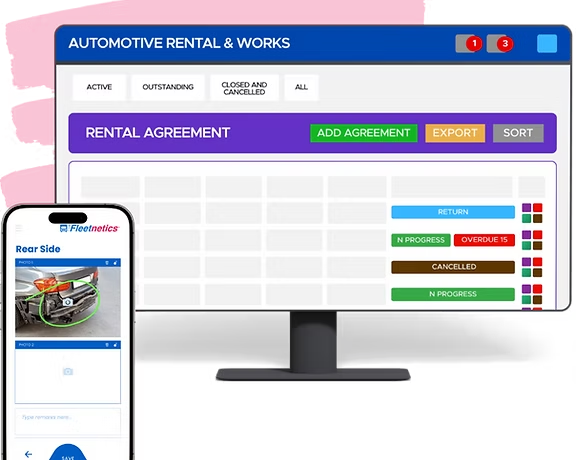
Rental and Leasing Management runs the agreement lifecycle. It moves a Rental Quotation into an Advance Booking, then into a Rental Agreement, then through Check Out and Check In, with Non Revenue Trip logging for movements that earn nothing.
Workshop Management runs jobs, mechanics, service items and service packages, along with inventory and purchasing through the Supplier Purchase Order and Supplier Delivery Order chain. Mechanic records carry permit and course expiry dates, so a lapsed permit surfaces before it becomes a compliance problem.
Spare Parts Management covers stock across warehouses, with Parts Transfer moving stock between them and Goods Return Outwards handling what goes back to the supplier. Businesses whose product is the part itself run this as their main component, and parts distribution and retail is the page that covers it.
Vehicle Sales Management handles the sale of the asset rather than its use.
Finance Management closes the loop through accounts receivable and payable, accounting, journal entries and reports, so an operational document posts into the ledger without a second entry.
For a business owner, the practical test of any module list is whether it removes a re-entry step. A module that only adds another screen to update has not paid for itself.
What changes on a normal working day?
The category benefits sound abstract until you look at three ordinary moments.
A damage dispute. Damage marked on the vehicle layout at Check Out carries forward, so the record compounds across the vehicle's life instead of resetting with each rental. When a customer disputes a scratch, you compare two checklists side by side rather than relying on memory. Fleetnetics has captured over 900,000 digital checklists as of August 2026, which is a large body of evidence that would otherwise sit in photographs on staff phones.
A part leaving the counter. Stock counts drift when parts leave without a job number attached, so it helps when the system will not release a part except against the job that consumes it. The stock figure and the invoice then agree without a reconciliation step.
A billing decision. Rental billing runs on forward billing, charged before the rental period, or arrears billing, charged after it. Most operators settle on monthly billing, and the choice between forward and arrears is one of the few levers that changes your cash position without changing your rates.

For a decision maker, that third example is the one to hold onto, because a billing model change costs nothing to implement and moves working capital immediately.
How does automotive ERP software fit Singapore operations?
Local practicalities decide more implementations than feature lists do. Identity verification through Singpass shortens rental onboarding and reduces the risk of handing a vehicle to someone who is not who they claim to be, and a community background check adds a further layer before the keys move. Our note on checking a driver before handing over keys covers how that check works in practice.
Customer communication matters just as much, and template messages over WhatsApp handle checkout notices and service reminders without a staff member typing each one. The detail sits in our piece on customer updates over WhatsApp.
There is also the accounting side. When your operational records and your ledger sit in one system, the GST figures you report are drawn from the same documents your operations team raised, which removes an entire class of end-of-quarter discrepancy.
Where the wider DewTouch ecosystem fits. Fleetnetics is built by DewTouch Innovations, a Singapore software company founded in 2012 that also builds adjacent products for the same industry. One of them is Booknetics, an end-to-end booking platform for self-drive vehicle rental and chauffeur-driven services, which handles the customer-facing reservation while the ERP handles the agreement, the vehicle and the invoice behind it. If your rental business takes bookings online and manages them offline, that pairing is usually where the manual work is hiding.
How do you choose an automotive ERP system?
A structured evaluation protects you from buying a demo rather than a system. This sequence works for most SME buyers.
Write down your revenue lines first. The number of lines you run decides whether you need an ERP at all, so settle that before you look at any vendor.
Map every place a customer record currently lives. The count is usually higher than expected, and it tells you how much duplication the new system has to absorb.
Pick the two workflows that hurt most. Evaluate vendors against those two rather than against a feature checklist, because every vendor wins a checklist.
Ask how the operational document reaches the ledger. If the answer involves an export and an import, you are looking at two systems with a bridge rather than one system.
Test the awkward cases. Vehicle replacement mid-agreement, a part returned to a supplier, and a deposit refunded on a disputed damage claim will tell you more than a happy-path demo.
Confirm what happens to your existing data. Ask specifically who cleans it, who imports it, and what the system does with records that fail validation.

If you are still at the comparison stage, our overview of comparing fleet management software in Singapore covers how the local options line up, and the industries this covers shows which operating models the platform is built around.
The short version
Automotive ERP software earns its place when your business has outgrown the joins between separate tools. It is one shared record of vehicles, customers, jobs, parts and money, and its value shows up in the re-entry steps it removes rather than in the length of its feature list.
Fleetnetics has been built for this exact audience since 2012, and as of August 2026 the platform has maintained over 450,000 vehicles and processed more than 1.3 million workshop jobs for car rental operators, workshops and parts businesses across four countries. Fleetnetics reports 99% customer retention, and you can read how one operator made the move.
No commitment. We will map your rental, workshop and parts records as they stand today and show you exactly where the same detail is stored twice. Get a demo →
Frequently asked questions
What is automotive ERP software in simple terms?
Automotive ERP software is one system that runs the operations and the accounts of an automotive business together. It stores vehicles, customers, jobs, parts, agreements and invoices on a shared database, so a change in one place updates everywhere else. Rental firms, workshops and parts businesses use it instead of running three or four disconnected tools.
Is automotive ERP the same as workshop management software?
No. Workshop management software handles one department, covering job cards, mechanics and service scheduling. Automotive ERP covers that department alongside rental, parts, vehicle sales and finance, and it connects them through shared customer and vehicle records. A workshop with a single revenue line may need only the workshop tool.
Do small automotive businesses need an ERP system?
Not always. A business with one revenue line, a fleet under roughly twenty vehicles and one person handling admin can usually run well on a single point tool. The case for an ERP strengthens when staff re-key the same data into a second system, stock counts stop reconciling, or month-end close takes over a week.
What modules should an automotive ERP for a rental business include?
At minimum it should cover quotations, Advance Booking, rental agreements, Check Out and Check In with damage recording, rental billing on both forward and arrears models, and accounts receivable. Driver records and blacklist checks matter too, since they run at the point of booking. Non Revenue Trip logging is useful once your fleet moves for non-earning reasons.
How long does an automotive ERP implementation take?
It depends mostly on the state of your existing data rather than on the software. Cleaning up duplicate customer records, vehicle lists and the chart of accounts is normally the longest part of the project. Ask any vendor to quote the data preparation separately from the configuration, so you can see which half of the timeline you control.


